
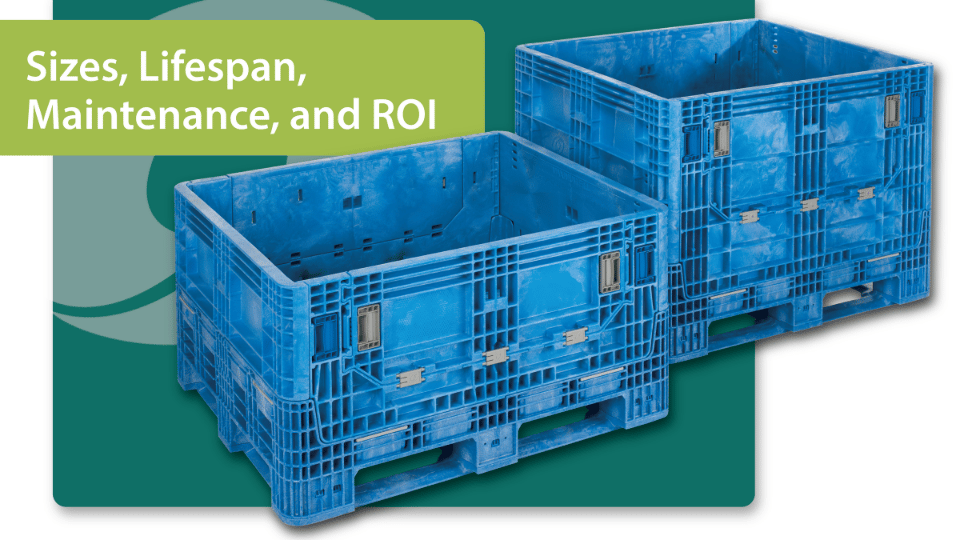
When automotive packaging engineers search for bulk containers, they often encounter results that mix together very different product categories. Reusable bulk containers for parts handling and intermediate bulk containers (IBCs) used for liquids are not the same thing, and evaluating them as if they were leads to the wrong spec, the wrong footprint, and the wrong investment.
This article is specifically about reusable bulk containers for automotive parts handling. These are solid-wall, collapsible, and stackable plastic containers designed to move, store, and stage components across supplier, warehouse, and plant environments.
The real evaluation criteria for automotive bulk containers are footprint, collapsibility, maintenance discipline, and AIAG compatibility – not liquid capacity or valve configurations.
As PwC’s 2026 Automotive Outlook notes, OEM margins remain under pressure, making supply chain cost reduction and packaging flexibility more important than ever. Choosing the right bulk container system is one of the most direct levers available to packaging and material handling teams.
TL;DR: Key Takeaways
Quick answers for automotive packaging teams:
ORBIS BulkPak containers are reusable bulk containers for automotive parts handling. They are not IBCs and are not designed for liquids or food.
The flagship 48×45 footprint is AIAG-standard and available in 17 SKUs, with heights from 19″ to 50″ and capacities from 1,500 to 2,000 lbs.
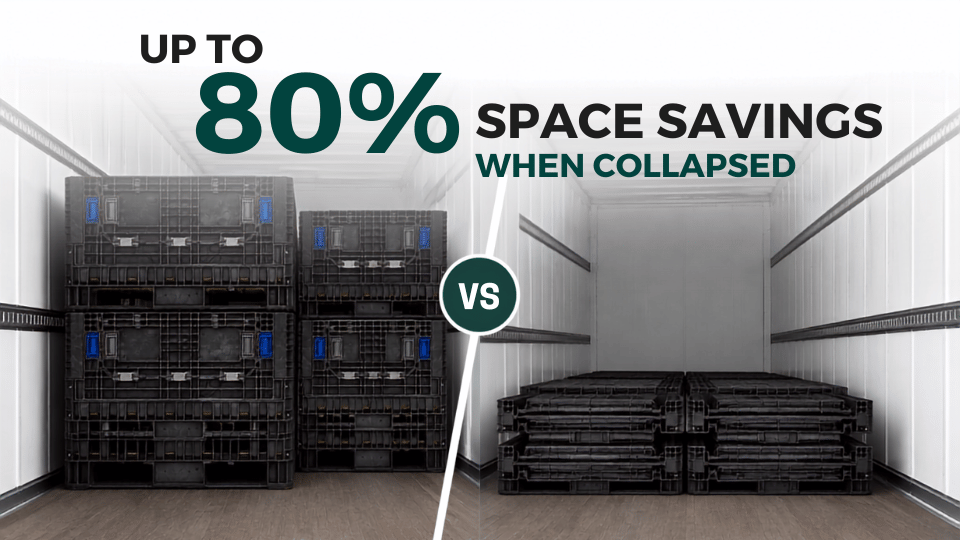
Collapsible design reduces empty storage footprint by up to 80%, directly lowering storage and return-flow costs.
Available in heavy duty and extreme duty ratings to match the demands of automotive handling environments.
Well-matched reusable bulk container programs typically achieve ROI within 6 months to 1.5 years.
Table of Contents
What Are Bulk Containers in Automotive Supply Chains?
In the context of automotive manufacturing and supply chain logistics, bulk containers are large, reusable plastic containers used to transport, store, and stage solid parts and components. They are not intermediate bulk containers (IBCs), which are designed for liquids, chemicals, or semi-liquids and operate on entirely different specifications.
These containers are purpose-built for solid parts handling – not for storing liquids, chemicals, or food products.
Automotive dry bulk containers are evaluated on different criteria entirely: footprint compatibility, load capacity, collapsibility, stacking stability, and integration with existing AIAG pallet systems and plant racking.
Common Automotive Applications
Reusable dry bulk containers are used across the automotive supply chain for:
Stamped metal parts and body panels
Plastic trim components and fascias
Engine and drivetrain subassemblies
Seat frames and structural components
Oversized or irregularly shaped parts requiring extended footprints
As C.H. Robinson’s freight market insights note, automotive freight flows are becoming less vehicle-centric and more component-driven, with more frequent, smaller shipments between suppliers and assembly plants. That shift favors flexible, collapsible bulk container systems that can adapt to variable load profiles without creating empty-space waste on return trips.
The automotive packaging market is projected to grow from USD 9.58 billion in 2025 to USD 16.21 billion by 2035, reflecting sustained demand for standardized, reusable parts-handling systems across global supply chains.
Ready to protect your automotive parts?
How Long Do Reusable Dry Bulk Containers Last?
Reusable bulk containers are engineered for multi-year service in demanding industrial environments. However, quoting a single lifespan number without context is misleading. Actual service life depends on load profile, handling frequency, storage conditions, and how consistently maintenance protocols are followed.
For automotive operations running high-cycle parts flows, the more useful metric is cost per trip over usable service life, not years in service. A bulk container that is maintained properly will deliver significantly more trips, and lower per-trip cost, than one that is underspecified for its application.
Factors That Determine Bulk Container Lifespan
| Factor | Impact on Lifespan |
|---|---|
| Load weight consistency | Exceeding rated capacity accelerates stress fractures and hinge wear |
| Handling equipment | Forklift contact with sidewalls is a leading cause of premature damage |
| Collapse and restack discipline | Improper collapsing stresses latches, hinges, and corner posts |
| Storage conditions | UV exposure and temperature extremes degrade plastics over time |
| Inspection frequency | Catching minor damage early prevents escalation to decommission |
Industry guidance on reusable packaging asset management recommends a condition-based classification approach rather than age-based replacement. Assets in good structural condition continue in production use (A-grade), those with minor wear are redirected to internal flows (B-grade), and those requiring repair or decommissioning are assessed accordingly (C-grade). This framework, outlined in reusable asset lifecycle guidance from organizations like the GIZ, helps operations maximize asset value without relying on arbitrary replacement timelines.
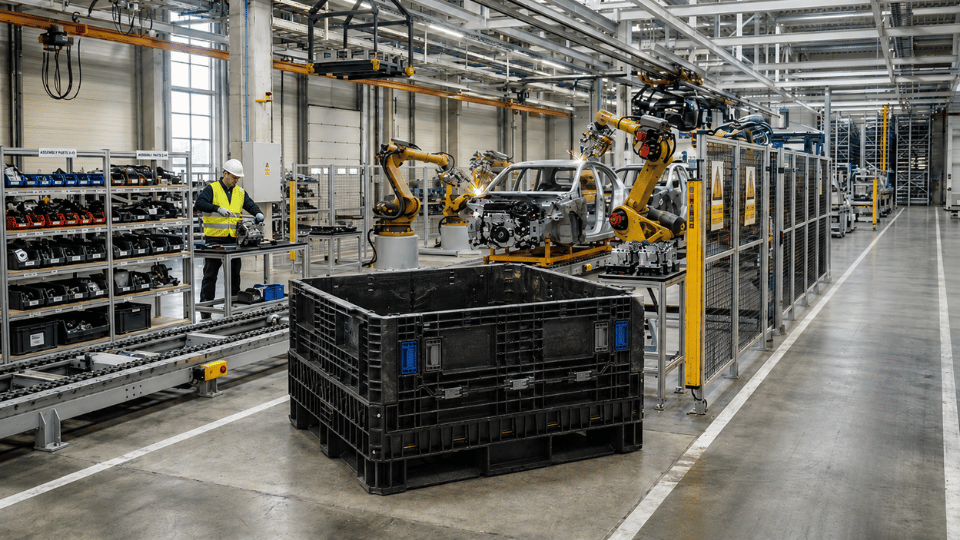
What Sizes Are Available? BulkPak Footprints and Capacity Options
ORBIS BulkPak collapsible bulk containers are available across a wide range of footprints to cover the full spectrum of automotive parts handling, from small components to oversized assemblies, as well as global supply chain applications requiring Euro-standard sizing.
BulkPak Size Comparison Table
| Footprint | Best For | Heights Available | Capacity |
|---|---|---|---|
| 48×45 (AIAG standard) | Standard automotive parts; integrates with AIAG pallet systems and racking | 19″ to 50″ (17 SKUs) | 1,500 to 2,000 lbs |
| 40×48 | International shipments; alternative standard footprint | Multiple heights | Up to 2,000 lbs |
| 30×16 | Smaller components; line-side space optimization | Multiple heights | Up to 500 lbs |
| 56×48 | Lengthy or challenging components | Multiple heights | Heavy-duty rated |
| 62×48 | Long, heavy components with industry-leading cube utilization | Multiple heights | Heavy-duty rated |
| 65×48 | Heavy, long automotive parts | Multiple heights | Up to 2,000 lbs |
| 70×48 | Extended automotive parts; rust-free alternative to metal containers | Multiple heights | Heavy-duty rated |
| 78×48 | Oversized, hard-to-fit automotive parts and appliances | Multiple heights | Heavy-duty rated |
| 1200×800 | European supply chains; 900 kg capacity | Multiple heights | 900 kg |
| 1000×800 | Euro-standard logistics flows | Multiple heights | Euro-rated |
| 1200×1000 | Larger Euro-format shipments; global automotive programs | Multiple heights | Euro-rated |
How to Select the Right Footprint
Start with the 48×45 if your operation already uses AIAG-standard pallets and racking. The 17-SKU range means height and capacity can be dialed in without changing the floor footprint.
Move to extended footprints (56×48 through 78×48) when parts length exceeds what a standard 48×45 can accommodate without overhang or damage risk.
Use Euro sizes for cross-border flows into or out of European plants, or where Euro-pallet compatibility is required by a customer or logistics partner.
Consider the 30×16 for line-side applications where floor space is constrained and smaller component batches are staged frequently.
Ready to spec the right container for your operation?
Best Practices for Maintaining Collapsible Bulk Containers
Maintenance discipline is what separates a reusable bulk container program that delivers multi-year ROI from one that accumulates damage, shortens asset life, and requires premature replacement. The following protocols apply to collapsible dry bulk containers used in automotive parts handling.
Inspection Protocol
Inspect containers at three points in every cycle:
At receipt – Check for structural damage, cracked sidewalls, bent corner posts, and latch or hinge issues before the container enters the flow.
Before loading – Confirm the container is clean, properly assembled, and rated for the load being placed.
After return – Document any damage before the container is collapsed and restacked, so repair decisions can be made before the next trip.
Cleaning and Contamination Control
Even though these containers are not used for liquids or food, residue from parts, lubricants, or plant environments can accumulate. Cleaning protocols should be matched to the residue type and volume:
Low-volume operations: manual wipe-down with appropriate industrial cleaner
Higher-volume programs: automated wash lines with documented cleaning records, as recommended by the GIZ’s implementing reusable packaging systems guide
Collapse, Storage, and Repair
Always collapse containers according to the manufacturer’s sequence to avoid stressing latches and hinges
Store collapsed containers on a flat, stable surface to prevent warping under stack weight
Assess damaged containers using a condition-based framework: minor structural damage may be repairable; compromised corner posts or cracked load-bearing walls typically warrant decommissioning
Maintain a repair log to track which containers require intervention and at what cycle count
Consistent application of these protocols directly extends service life and strengthens the financial case for reusable bulk container programs.
Find the right reusable bulk container for your operation
What Are the Benefits of Bulk Containers in Automotive?
Reusable dry bulk containers deliver operational and financial benefits across every stage of the automotive supply chain, from supplier to warehouse to plant floor. The case for switching from expendable packaging is increasingly driven by cost efficiency and operational performance, not just sustainability, as the reusable packaging market (valued at over USD 141.3 billion in 2025) continues to demonstrate.
Operational Benefits
Part protection: Rigid sidewalls and consistent container geometry reduce part-on-part contact and damage during transit and staging.
Stackability: Designed for stable stacking in loaded and empty configurations, improving storage density and trailer cube utilization.
Handling consistency: Standardized footprints reduce variability in forklift handling, line-side delivery, and racking systems.
AIAG compatibility: The 48×45 footprint integrates directly with existing AIAG pallet systems and racking without requiring infrastructure changes, which is a meaningful advantage for operations that have already standardized on AIAG dimensions. See how ORBIS plastic pallets for automotive complement this system.
Financial Benefits
Empty storage footprint reduced by up to 80%: Collapsible design means containers take up a fraction of the space when empty, reducing storage costs and improving return-trip efficiency.
Expendable packaging elimination: Replacing corrugated, wood, or single-use containers removes per-trip material and disposal costs from the operation.
Labor savings: Standardized containers reduce the time spent on sorting, damage inspection of incoming parts, and packaging disposal.
ROI timeline: Well-matched reusable dry bulk container programs typically achieve full return on investment within 6 months to 1.5 years, depending on trip frequency, expendable packaging spend displaced, and damage reduction achieved.
The financial case is strongest when the container spec (footprint, height) is matched precisely to the parts being handled and the handling environment, rather than defaulting to a generic size.
Why ORBIS BulkPak Fits Automotive Parts Handling
Most bulk container pages on the market either stay at a catalog level or blur the distinction between dry parts containers and liquid-handling systems. That ambiguity creates real risk for packaging engineers who need to specify the right asset class for the right application.
ORBIS BulkPak is purpose-built for automotive parts handling. The product line is designed around the specific demands of automotive supply chains:
Category clarity: BulkPak containers are designed for solid parts handling – not liquids, not food. That distinction matters when specifying for automotive plant environments.
AIAG-first design: The flagship 48×45 footprint is the AIAG-standard platform, meaning it works with the pallet and racking infrastructure most North American automotive operations already have in place.
Configurable across the full range: With footprints from 30×16 to 78×48, plus Euro sizes for global programs, and two duty ratings, BulkPak gives packaging engineers a single reusable system that covers small components through oversized assemblies.
Collapsibility as a core feature: The up to 80% empty-footprint reduction is not a secondary benefit. In automotive supply chains where return logistics and storage density are cost drivers, collapsibility is a core part of the value proposition.
The combination of AIAG compatibility, footprint range, and collapsible design makes ORBIS BulkPak one of the most complete dry bulk container systems available for automotive applications.
Next Step: Match the Right BulkPak Configuration to the Job
Selecting the right bulk container is a systems decision. Footprint, height, and collapsibility all interact with your parts profile, handling environment, storage density requirements, and return logistics. Getting that match right is what determines whether a reusable bulk container program delivers on its ROI potential.
To find the right ORBIS BulkPak configuration for your application:
Identify your primary footprint need – Start with 48×45 for AIAG-standard operations, or select an extended footprint for oversized parts.
Factor in empty-return logistics – Collapsible containers reduce return-trip storage costs by up to 80%, which should be part of the total cost calculation.
Account for global flows – If your supply chain crosses into European operations, Euro-size options (1200×800, 1000×800, 1200×1000) provide the compatibility you need.
Request a quote for ORBIS collapsible bulk containers