
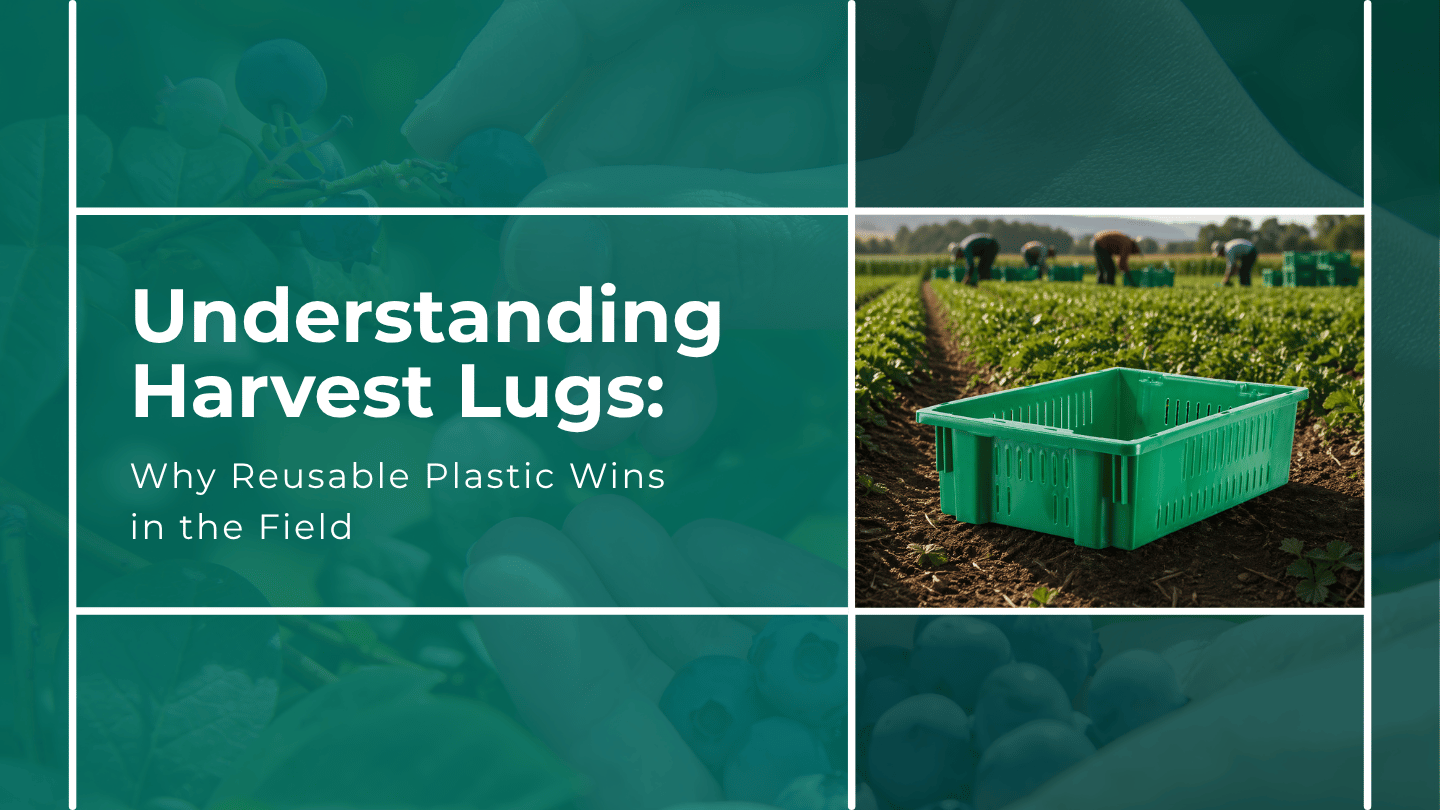
Every harvest season, produce growers and packhouse managers face the same calculation: which containers will protect the crop, hold up through repeated handling, and still make economic sense by the end of the season? For most operations, that question comes down to a choice between corrugated cartons, wooden crates, and reusable plastic harvest lugs.
The answer has shifted decisively in recent years. Reusable produce containers now handle over 60% of fresh produce in EU and North American retail, according to Coherent Market Insights, and the data behind that adoption is hard to argue with. This guide explains what harvest lugs are, how they differ from other container types, and why reusable plastic outperforms single-use alternatives at every stage of the supply chain.
Key takeaway: Reusable plastic harvest lugs reduce logistics costs by 15-25%, cut produce damage by up to 98% (Fraunhofer Institute, 2025), and can reduce postharvest losses from a typical 30% down to 5% or less, according to the Postharvest Education Foundation.
Table of Contents
Why Harvest Lugs Outperform Corrugated Across the Supply Chain
ORBIS Agricultural Containers: Built for the Full Harvest Cycle
What Are Harvest Lugs?

Harvest lugs are handheld agricultural containers used to collect, transport, and stage fresh produce from the field through processing and distribution. The term “lug” has its roots in the produce industry, historically referring to a shallow wooden box used to pack fruit for shipment. Today, the name applies broadly to a category of reusable plastic handheld containers designed for field picking, in-plant handling, and the full grower-to-retailer supply chain.
You will encounter several terms used interchangeably for the same product family:
Harvest lugs – the traditional industry term, widely used by growers and packhouses
Handheld harvest totes – common in procurement and distribution contexts
Agricultural handheld containers – the formal product category designation
Agricultural RPCs (Reusable Plastic Containers) – used when containers move through pooled or closed-loop systems
Produce bins / vented harvest bins – descriptive terms emphasizing ventilation and produce handling
Harvest crates / field picking containers – terms common in orchard, vineyard, and row crop applications
Grower-to-retailer crates – used when containers travel the full supply chain from farm to retail floor
What They Are Used For
Harvest lugs serve multiple roles across the agricultural supply chain:
Field harvest – workers pick directly into lugs, reducing double-handling
In-plant staging and processing – lugs move from field to packhouse without repacking
Cold storage – ventilated designs maintain airflow during pre-cooling and refrigerated storage
Distribution – stack-and-nest configurations optimize pallet density for transport
Retail staging – some designs support direct display without unpacking
The key design features that make a container a harvest lug rather than a general-purpose bin are its ergonomic handholds, ventilated walls and base, stack-and-nest capability, and footprint compatibility with standard 40×48 pallets.
How Harvest Lugs Compare to Corrugated and Wood
| Factor | Reusable Plastic Lugs | Corrugated Cartons | Wood Crates |
|---|---|---|---|
| Durability | Designed for repeated reuse across multiple seasons | Typically single use; discarded after one trip | Reusable in some operations, but degrades in wet or high-humidity environments |
| Sanitation | Non-porous; washable and sanitizable to science-based standards | Absorbs moisture; cannot be effectively sanitized once wet | Absorbs moisture and odors; surface splinters create contamination risk |
| Ventilation | Engineered vents support consistent airflow and pre-cooling | Limited ventilation; structural integrity weakens when wet | Ventilation gaps are inconsistent across units |
| Produce damage | Smooth interior surfaces and radius corners minimize bruising | Weakens under load or moisture, reducing product protection | Splinter risk and uneven interior surfaces can damage soft produce |
| Weight | Lightweight plastic construction eases repeated field handling | Lightweight when dry; collapses under load when wet | Significantly heavier than plastic alternatives, increasing worker fatigue |
| Return logistics | Stack-and-nest design reduces empty return volume by 70-80% | Crushed or discarded after use; no return value | Bulky when empty; return freight costs are high relative to useful life |
| Food safety | Available in FDA-approved food contact materials | Moisture absorption increases contamination risk in wet environments | Wood grain and surface damage create harborage points for bacteria and pests |
| Environmental impact | 31% less global warming potential, 86% less solid waste vs. single-use (Franklin Associates) | High per-trip waste volume; no reuse value | Requires ongoing replacement; higher lifecycle resource consumption |
Why the Numbers Favor Reusable Plastic
The comparison above reflects real operational data, not just product claims. A life cycle assessment by Franklin Associates found that reusable plastic containers generate 31% less global warming potential, 86% less solid waste, 80% less water use, and 64% less energy consumption compared to single-use packaging over equivalent product throughput.
The break-even point is faster than most operations expect. According to the Postharvest Education Foundation, reusable plastic containers can reduce postharvest losses from a typical 30% down to 5% or less – a payback that for many operations comes within a single growing cycle.
The produce damage figure deserves particular attention. A 2025 study by the Fraunhofer Institute for Material Flow and Logistics found that switching from single-use to reusable containers reduced fresh produce damage by approximately 98%. For context, annual product loss in Germany from single-use packaging was estimated at 64,000 metric tons; with reusable containers, that figure dropped to 1,200 metric tons. The revenue protection impact alone often justifies the transition before factoring in container longevity or logistics savings.
Find the right harvest lug for your operation.
What to Look for When Choosing a Harvest Lug
Not all reusable produce bins are designed equally. The right harvest lug for a berry operation differs from the right one for a citrus or root vegetable harvest. These are the design features that have the most direct impact on field performance and supply chain efficiency.
Ventilation Design
Ventilated walls and drain-hole bases serve two purposes: they allow rapid pre-cooling after harvest, and they prevent moisture buildup that accelerates spoilage. For cold chain operations, consistent airflow through stacked containers is critical. Research from Future Market Insights confirms that RPCs with engineered ventilation extend perishable goods shelf life by 2-3 days compared to non-ventilated alternatives. For retailers and distributors, that shelf life extension directly reduces shrink.
Stack-and-Nest Capability
Stack-and-nest harvest crates address one of the most persistent logistical challenges in produce handling: the return trip. When full, containers stack securely for transport and cold storage. When empty, a 180-degree rotation allows them to nest inside each other, reducing return volume by 70-80%.
This matters beyond just transportation cost. Packhouses and distribution centers that handle high container volumes need efficient empty storage. Stack-and-nest designs free up warehouse floor space during off-peak periods and reduce the labor required to manage empties.
Ergonomics and Worker Handling
Field workers carry harvest lugs repeatedly throughout a shift. Container weight, handle placement, and grip design have a direct effect on picking speed and worker fatigue. Reusable plastic lugs typically weigh around 2-5 lbs empty, compared to 30-70 lbs for equivalent wood crates. Smooth ergonomic handles, radius corners that prevent product bruising, and consistent dimensions that allow secure stacking all contribute to faster, safer picking.
Footprint and Pallet Compatibility
Most commercial harvest operations run on standard 40×48 pallets. Harvest lugs designed to fit 4-up or 5-up on a standard pallet maximize cube utilization and reduce the number of pallet positions required in cold storage and transport. Containers that do not conform to standard pallet footprints create inefficiencies at every downstream stage.
FDA-Compliant Materials
For fresh produce, food safety compliance is not optional. Reusable plastic harvest lugs are available in FDA-approved materials that meet food contact requirements. Unlike wood, plastic does not absorb moisture, bacteria, or odors. The Reusable Packaging Association notes that reusable containers are inspected, washed, rinsed, sanitized, and dried to science-based standards before each reuse cycle, with no detected food safety risks across billions of global uses annually.
Why Harvest Lugs Outperform Corrugated Across the Supply Chain
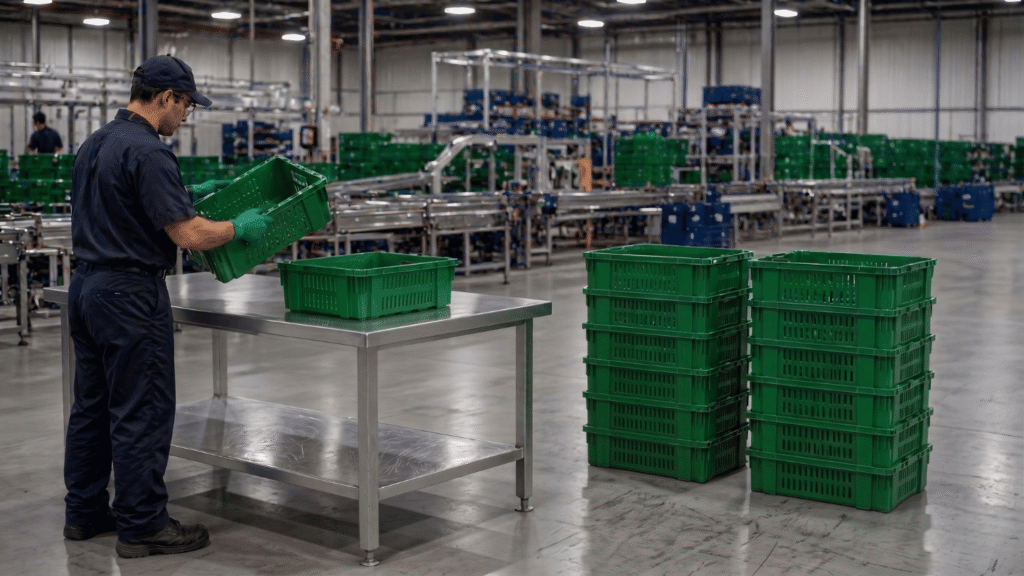
The economic argument for reusable harvest lugs strengthens as you trace the container further through the supply chain. Single-use corrugated cartons create a cost event at every stage: purchasing, disposal, and the operational friction of managing containers that degrade under load or moisture. Reusable plastic containers invert that model.
Logistics Cost Reduction
Industry data from Future Market Insights places logistics cost reduction at 15-25% for operations that transition to reusable produce bins. The savings come from multiple sources:
Fewer replacement container purchases per season
Reduced waste disposal costs
More efficient pallet loading due to consistent container dimensions
Lower return freight costs from stack-and-nest volume reduction
Reduced labor for container management at packhouse and distribution stages
A five-year program analysis from UMass Amherst found net savings of $265,563 from a reusable container program, alongside a reduction of 20 metric tons of trash and 100 metric tons of avoided carbon emissions from manufacturing and transport.
Food Waste Reduction
The connection between container choice and food waste is direct but often underappreciated. Reusable plastic containers reduce food waste by up to 20% compared to single-use packaging, according to Coherent Market Insights. The mechanisms are ventilation-driven cooling, structural protection that prevents bruising, and the shelf life extension that comes from consistent temperature management through the cold chain.
Sustainability and Regulatory Alignment
Sustainability requirements are tightening across the food supply chain. The EPA’s Sustainable Management of Food program identifies reusable packaging as a primary lever for reducing agricultural supply chain waste, and retailer sustainability programs increasingly require suppliers to demonstrate packaging improvements. Over 10 billion single-use boxes have been replaced by reusable packaging globally, avoiding an estimated 3.2 million metric tons of CO2 emissions as of 2025.
Reusable plastic harvest lugs also support circular economy commitments: they are fully recyclable at end of service life, and programs like ORBIS’s Reusable Packaging Management (RPM) provide closed-loop management that tracks, cleans, and redeploys containers across seasons.
ORBIS Agricultural Containers: Built for the Full Harvest Cycle
ORBIS offers a range of harvest lugs designed to support growers and packhouses from field picking through distribution.
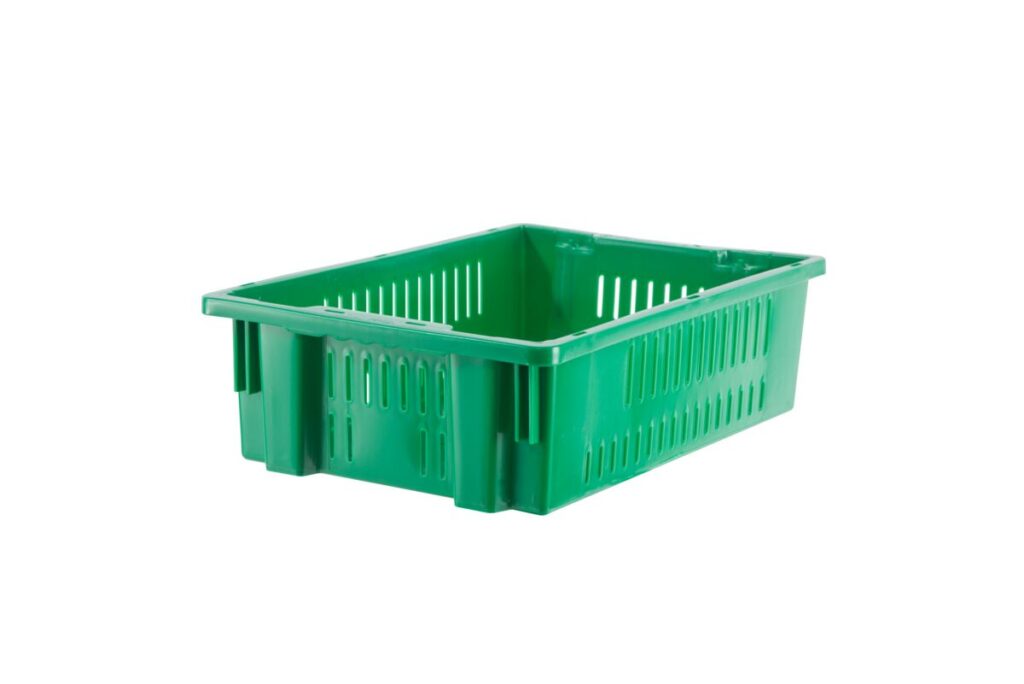
Available in multiple footprints (21×13, 24×16, and 24×20) and depths, the lineup covers everything from shallow berry trays to deeper harvest lugs for citrus, stone fruit, and root vegetables.
Container Options at a Glance
| Model | Footprint | Depth |
|---|---|---|
| AF2416-6 / NPL675 | 24×16 | 7.5 in |
| AF2416-10 / NPL665 | 24×16 | 10.2 in |
| AF2416-13 / NPL665 | 24×16 | 13.2 in |
| AF-1 | 24×20 | 6.8 in |
| AF-21 | 24×20 | 13.4 in |
| NO2113-7 NPL682 | 21×13 | 7.1 in |
Each container is built with ventilated walls, smooth interior surfaces, ergonomic handholds, and stack-and-nest functionality – the core features that separate purpose-built harvest lugs from general-purpose bins.
Containers are available in FDA-approved materials for food contact applications and are fully recyclable at end of service life. For operations that require closed-loop container management, ORBIS’s Reusable Packaging Management program handles tracking, washing, and redeployment across seasons.
Ready to protect your produce from field to retailer?
Making the Transition: What to Consider Before Switching
Transitioning from corrugated or wood to reusable plastic harvest lugs is straightforward for most operations, but a few practical considerations will determine how quickly you see returns.
Volume and container pool size. The efficiency gains from stack-and-nest logistics and reduced replacement purchasing scale with volume. Operations running 5,000 or more container turns per season typically see the strongest ROI. For smaller operations, shared or pooled container programs can provide the same benefits without the upfront capital of a full proprietary fleet.
Washing and sanitation infrastructure. Reusable containers require cleaning between uses. Most commercial packhouses already have wash-down infrastructure compatible with plastic containers. For operations without existing wash capability, ORBIS’s RPM service provides managed washing and redeployment as part of the program.
Crop compatibility. Container depth, ventilation pattern, and interior surface finish matter differently depending on the crop. Soft fruits like berries and grapes require shallower containers with fine ventilation to prevent bruising and maintain airflow. Root vegetables and citrus tolerate deeper containers with coarser venting. ORBIS offers multiple configurations specifically for this reason.
Downstream compatibility. If your containers travel through a distribution center or to a retail partner, confirming pallet footprint compatibility and stack height requirements before selecting a container model avoids costly adjustments later.
The reusable plastic containers market for agriculture is valued at $442.9 million in 2026 and projected to grow at a 9.5% CAGR through 2033, according to Coherent Market Insights. The growers and distributors moving now are building supply chain infrastructure that will compound in value as the market standard shifts further away from single-use alternatives.
The choice of harvest container is not a minor procurement decision. It shapes produce quality, worker efficiency, food safety compliance, and supply chain cost from the first pick of the season to the retail shelf. The evidence is consistent: reusable plastic harvest lugs outperform corrugated and wood on every dimension that matters to growers, packhouses, and distribution teams.
The transition pays back faster than most operations expect, and the compounding benefits across seasons make the case stronger every year.
Talk to an ORBIS expert about your harvest container needs.
Frequently Asked Questions
What is a harvest lug?
A harvest lug is a handheld reusable plastic container used to collect, transport, and stage fresh produce from the field through processing and distribution. The term originates from the produce industry, where shallow wooden boxes were historically used to pack fruit for shipment. Today, harvest lugs are injection-molded plastic containers with ventilated walls, ergonomic handles, and stack-and-nest capability designed for commercial agricultural operations.
What is the difference between a harvest lug and an RPC?
Harvest lugs and RPCs (Reusable Plastic Containers) refer to the same broad category of container. “Harvest lug” is the field-level term used by growers and packhouses, while “RPC” is more common in distribution, retail, and pooling-system contexts. Both describe reusable plastic handheld containers designed for fresh produce handling across the supply chain.
How long do reusable plastic harvest lugs last?
Reusable plastic harvest lugs are designed for repeated use across multiple growing seasons. With proper washing, inspection, and storage between uses, containers can remain in service for many years. ORBIS containers are also fully recyclable at end of service life, supporting closed-loop circular economy programs.
Are reusable harvest lugs food safe?
Yes. ORBIS agricultural containers are available in FDA-approved food contact materials. Unlike wood, plastic does not absorb moisture, bacteria, or odors. The Reusable Packaging Association notes that reusable containers are inspected, washed, rinsed, sanitized, and dried to science-based standards before each reuse cycle, with no detected food safety risks across billions of global uses annually.
What size harvest lug do I need?
The right size depends on your crop, picking volume, and downstream pallet requirements. Shallow containers (6-8 in depth) are suited to soft fruits like berries, grapes, and tomatoes. Deeper containers (10-13 in) work better for citrus, stone fruit, root vegetables, and higher-volume harvests. ORBIS offers configurations in 21×13, 24×16, and 24×20 footprints to cover a wide range of applications.
How do stack-and-nest harvest crates work?
Stack-and-nest containers are designed to stack securely when full for transport and cold storage, and nest inside each other when empty by rotating 180 degrees. This reduces empty return volume by 70-80%, significantly lowering return freight costs and storage space requirements at packhouses and distribution centers.
Can harvest lugs be used in automated packing lines?
Yes. ORBIS agricultural containers are designed with consistent dimensions and standard 40×48 pallet compatibility, making them suitable for automated handling systems. Consistent footprints and stack heights ensure repeatable performance in conveyor, sorting, and picking line environments.
What is the difference between corrugated cartons and reusable plastic harvest lugs?
Corrugated cartons are single-use and degrade under moisture, which is common in fresh produce environments. They cannot be effectively sanitized once wet and generate significant waste per season. Reusable plastic harvest lugs are non-porous, washable, structurally stable under load and moisture, and designed for repeated use. A life cycle assessment by Franklin Associates found that reusable plastic containers generate 31% less global warming potential and 86% less solid waste compared to single-use corrugated alternatives.